21
Free MD5 Generator: Online MD5 Hash Calculator (2025)
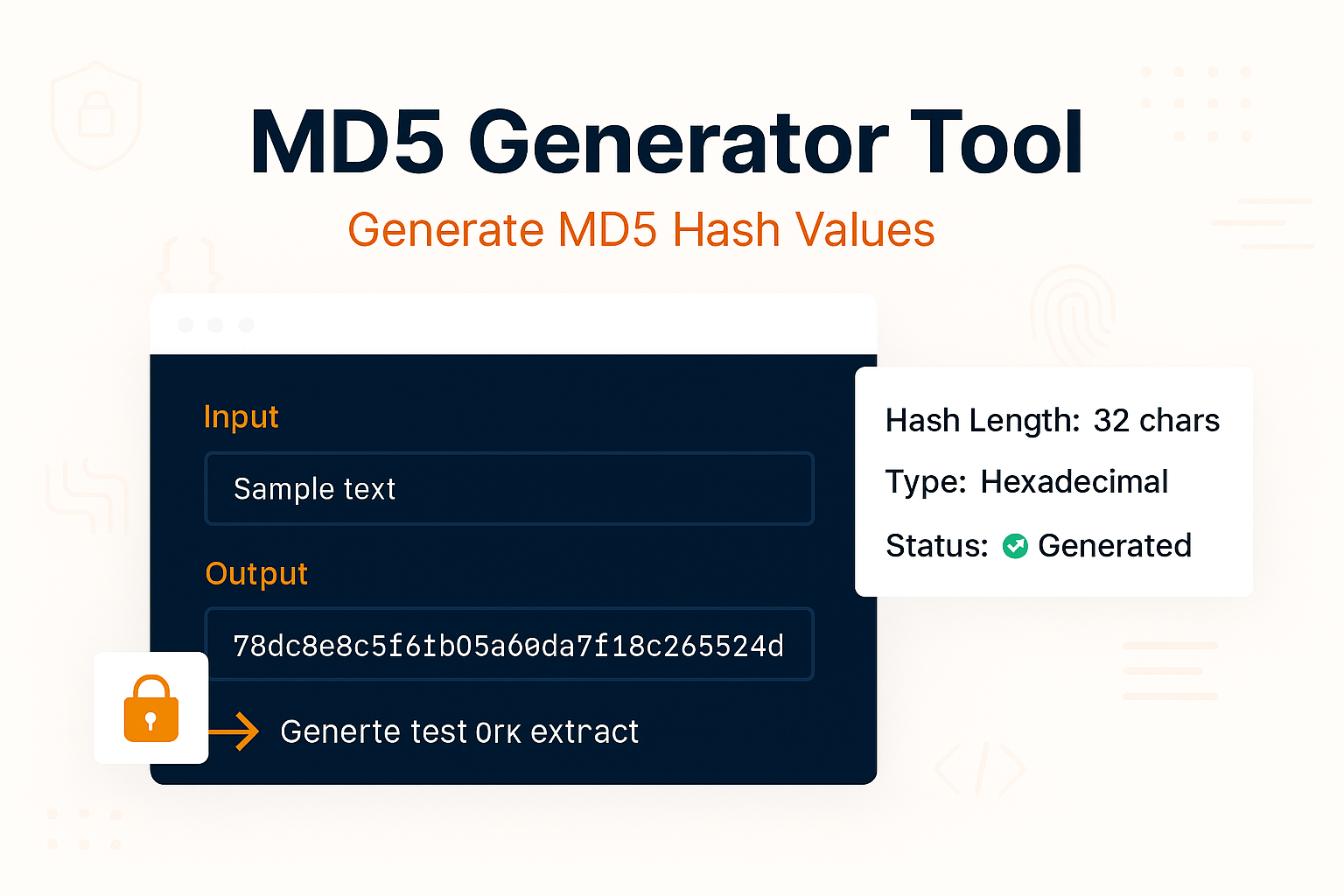
Instantly generate the MD5 hash for any text, string, or file. Our free online MD5 hash calculator creates a 32-character hexadecimal hash. Perfect for file integrity checks and data verification.
How can you be sure that the file you just downloaded is the *exact* file the developer intended for you to have? How can you tell if data has been tampered with or corrupted?
The answer is a "hash." An MD5 hash is a 128-bit (32-character) "digital fingerprint" or "checksum" for any piece of data. If even one character in the data changes, the MD5 hash will change completely. Our free MD5 Generator is a simple tool that lets you generate this unique hash from any text or string.
This tool is essential for developers verifying data integrity, IT professionals checking file checksums, and students learning about cryptography and hashing functions.
What Is an MD5 Hash?
MD5 stands for "Message-Digest algorithm 5." It's a one-way cryptographic hash function.
- Hash Function: It's a mathematical algorithm that takes any input (of any size) and converts it into a fixed-length string of text. For MD5, this is always a 32-character hexadecimal string.
- One-Way: This is the most important part. It's easy to go from your text to the hash, but it is mathematically impossible to go from the hash back to your original text.
How to Use Our MD5 Generator
- Step 1: Navigate to our free MD5 Generator.
- Step 2: Type or paste your text (or "string") into the input box.
- Step 3: Click the "Generate" button.
- Step 4: The tool will instantly display the 32-character MD5 hash. You can copy it to your clipboard.
The Top Use Cases for MD5
1. File Integrity Verification (The Best Use)
This is the most common and secure use for MD5 today. When you download a large file (like a Linux ISO, a software update, or a large dataset), the source website will often provide the MD5 hash.
After you download the file, you can generate your *own* MD5 hash from it (using a command-line tool or our generator if it's text). If your hash matches the one on the website, you know 100% that your file is not corrupted and has not been tampered with.
2. Password Hashing (An Outdated Use - A Warning!)
For many years, developers would store user passwords as MD5 hashes. When a user tried to log in, the system would hash their password attempt and compare it to the stored hash.
This is no longer secure! Because MD5 is so fast, hackers have created "rainbow tables"—massive databases of pre-computed hashes. They can use these to "crack" MD5-hashed passwords in seconds.
For secure password hashing, you should use modern, slow algorithms like Bcrypt. You can use our Bcrypt Generator for this.
MD5 vs. SHA: What's the Difference?
MD5 is an older algorithm. It has known "collision" vulnerabilities, meaning it's possible (though rare) for two different inputs to create the same hash. Because of this, it is not considered "cryptographically secure" for things like digital signatures.
SHA (Secure Hash Algorithm), particularly SHA-256, is the modern, more secure standard. It produces a longer, more complex hash that is not vulnerable to the same attacks.
Rule of Thumb:
- For simple file integrity checks (checksums), MD5 is fine.
- For anything security-related (passwords, signatures, etc.), use SHA-256 or Bcrypt. Check out our SHA Generator.
Frequently Asked Questions (FAQs)
Q: Is MD5 a form of encryption?
A: No. This is a common misconception. Encryption is two-way (you can encrypt and decrypt). Hashing is one-way (you can't "un-hash" it). You cannot get your original text back from an MD5 hash.
Q: Can MD5 be "reversed" or "decrypted"?
A: No. It cannot be mathematically reversed. However, because it's so common, hashes for simple passwords (like "123456") are easily "cracked" by looking them up in a pre-computed list (a rainbow table).
Q: Is MD5 secure?
A: It depends on the use. For checking if a file is corrupted, yes, it's perfectly fine. For storing passwords, NO, it is dangerously insecure.
Conclusion
The MD5 hash is a fundamental tool in computing. While it's no longer the king of security, it remains a fast, reliable, and standard way to create a "checksum" and verify data integrity. Use our free tool to generate any hash you need in seconds.
Related Hashing & Security Tools:
- SHA Generator - Generate modern, secure SHA-256 and SHA-512 hashes.
- Hash Generator - A tool that generates multiple types of hashes at once.
- Bcrypt Generator - The modern, secure standard for hashing and protecting passwords.
- Password Generator - Create strong, random passwords that are hard to crack.
Last Updated: October 21, 2025
Contact
Missing something?
Feel free to request missing tools or give some feedback using our contact form.
Contact Us